
Gastonia Directory Holdings by Year
Gastonia's historical volumes survive in several repositories, with a useful but incomplete run from 1910 through 1960. The earliest verified book is the 1910-1911 Piedmont Directory Co. volume. DigitalNC also verifies serial runs for 1913-1914, 1918-1919, 1921-1924, and 1927-1928. Hill Directory Co. appears in the record by 1934 and issued the later volumes found for this research. A city directory is a dated publication, not proof that every name or address remained unchanged throughout a year.
| Collection | Years | Where Held | Access |
|---|---|---|---|
| Piedmont Directory Co. Gastonia volume | 1910-1911 | DigitalNC and UNC Chapel Hill North Carolina Collection | Free catalog record and scan |
| Gastonia serial directories | 1913-1914, 1918-1919, 1921-1924, 1927-1928 | DigitalNC North Carolina City Directories collection | Search the title by year |
| Hill's Gastonia directories | 1934; 1936, 1938, 1940, 1942; 1945, 1947, 1949; 1951, 1953-1960 | DigitalNC and Allen County Public Library listings | Digitized collection listings and scans |
| Street and householder departments | 1910 street section; 1960 Hill section | DigitalNC scans and Gaston County Public Library | Address-to-occupant research |
| Telephone-book companions | 1925 and 1950 examples | Digital Gaston County through library resources | Use between directory editions |
The local historical reference used for the York-Chester area says Gaston County Library held Gastonia city directories from 1910 to 1960. That range has gaps and biannual books. It does not establish that every intervening year exists. When a desired year is absent, note the gap, check the closest surviving issue, and use a telephone book, newspaper, census, or map instead of assuming a household left town.
Gastonia Local-History Desk
The Gaston County Public Library is the practical first stop for the physical shelf and the related sources that make an old entry useful. Its Local History & Genealogy desk is at 1555 East Garrison Boulevard, Gastonia, NC 28054, and the listed phone is 704-868-2164. The library links researchers to City Directories, Census, yearbooks, cemeteries, Digital Gaston County, the Gaston Gazette Microfilm Index, and a guide titled “Researching the History of Your House in Gaston County.” Ask the local-history desk for the relevant volume, the street section, and the matching research guide.
Access differs by resource. Ancestry Library Edition is available inside the library because of vendor limits. HeritageHub supplies obituary and death-notice material with original images and is described as available around the clock. NewsBank includes the Gaston Gazette and Charlotte Observer with remote access described by the library. NC LIVE points patrons to Digital Sanborn Maps, DigitalNC, HeritageQuest, ArchiveGrid, and the Historic North Carolina Digital Newspaper Collection. The desk is also the fallback when a scan is missing, a directory needs context, or a catalog film has viewing restrictions.
Gastonia Directory Scans Online
DigitalNC is the clearest online path to the digitized volumes. Its catalog identifies the 1910-1911 book as a Piedmont Directory Co. publication in “The Piedmont Series,” with a UNC Chapel Hill North Carolina Collection call number and an Internet Archive scan connection. The record is especially useful because it ties the scanned pages to a repository rather than presenting an isolated image. Search the collection by title and year, then preserve the record link and page reference in your notes.
DigitalNC's Gastonia 1910-1911 directory record is the source for the digitized collection image below.
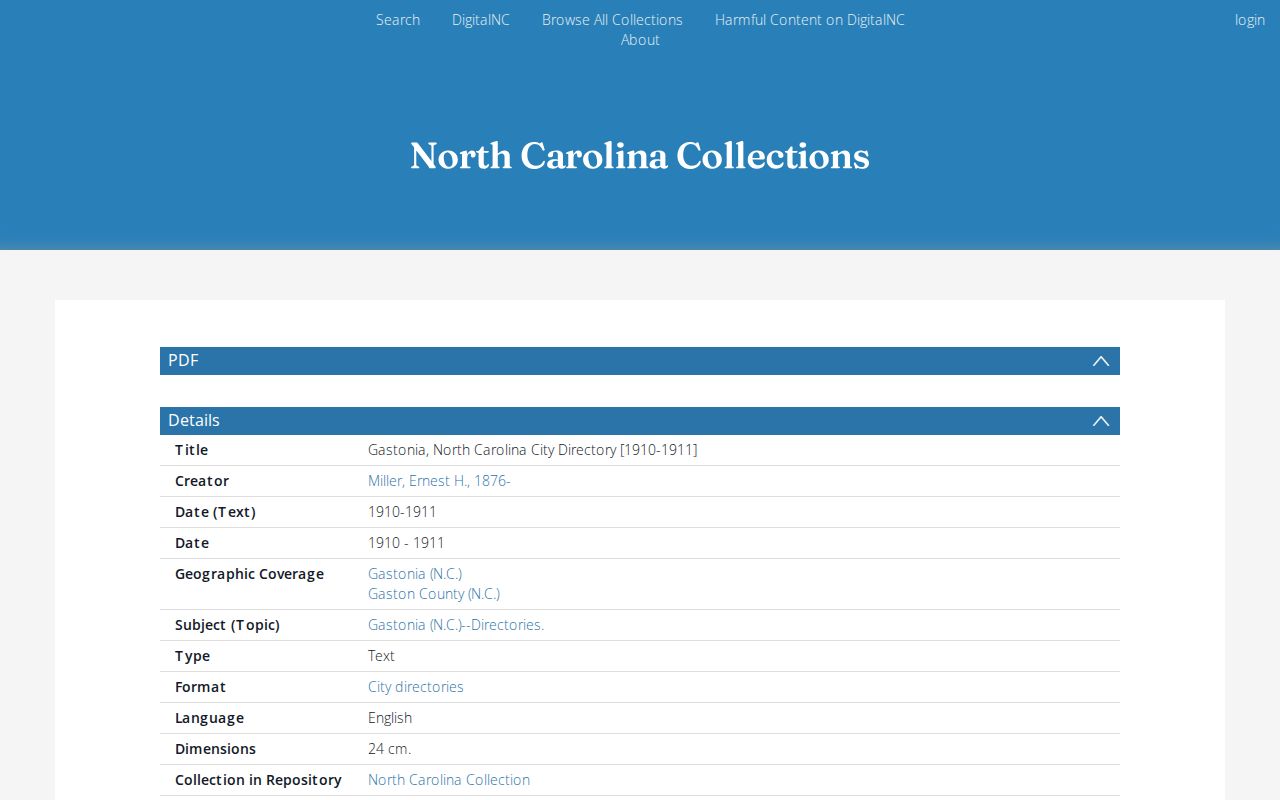
That catalog record gives the searcher a stable starting point before opening a scan, where page-by-page inspection is often needed for an address or an abbreviation key. The 1936 Hill's volume and the 1960 Hill introduction provide later comparison points, but a later publisher's format should not be projected onto the earlier Piedmont book.
Reading Gastonia Directory Entries
A Gastonia directory entry can answer more than one question, but each field needs a date. The 1910 street section is explicitly titled “Gastonia, N.C., Street Directory 1910” and says it gives names of householders while denoting business places. Its Airline Avenue sample includes street orientation, intersections, house or business numbers, people, firms, “Vacant,” and a rear or room notation. The 1960 introduction describes a broader four-part design with alphabetical names, a householder directory, a business catalog, and a numerical telephone directory.
| Name form | Adult resident, business, or concern; compare initials, “Mrs.” forms, and surname spelling across issues. |
|---|---|
| Household clue | Marital-status wording, spouse context, widow-style notation, or a householder placement may distinguish similar names. |
| Occupation or concern | The later introduction says entries aimed to show occupation and business context, which can separate two people with the same name. |
| Street position | Numbered streets precede named streets in the 1960 householder department; numbers run with occupants opposite. |
| Address marks | The 1910 key says a dash before a name means the number is wanting, and a star identifies a person as colored. |
- Criss-cross directory
- An address-first or street-and-householder section. It reverses the usual name-first route so a reader can begin with a number and street.
- Householder index
- The part of a volume that places occupants opposite numerical street addresses, often with intersecting streets for orientation.
- Abbreviation key
- The publisher's explanation of symbols and shortened words. Photograph or transcribe it before interpreting a mark in an entry.
Read the entry with its original key. A business listing can share a street page with a household, and “Vacant” records an observation from the publisher's compilation rather than a complete account of the property. The 1960 volume also includes telephone numbers and a printed ownership designation, while the earlier volume uses its own notation. Those differences are why the front matter matters.
Gastonia Street Guides
Street pages make old addresses usable when a surname search fails. The 1910 scan organizes streets and avenues alphabetically, describes their orientation, and lists intersecting avenues in sequence. The 1960 householder section orders numbered streets first and named streets alphabetically, with residence or business numbers arranged numerically. These layouts can show a nearby firm, cross street, or neighbor that helps identify the correct block.
Use that context carefully. Gastonia's historic-resource research warns that street numbering changed and that directories can be wrong. A street number in an older issue may not match a later parcel number. Keep the street name, intersections, lot or plat references, and adjacent names together. The modern parcel trail belongs to the Gastonia street address directory; the historical book remains the source for what its publisher printed in a particular year.
Gastonia Mill-Village Volumes
Some later directory searches need a wider place name. The 1960 Hill introduction says its edition includes Dallas, Flint Mills Villages Nos. 1 and 2, Groves Mills Village, Lowell, Ranlo, Smyre, and West View Heights. Gastonia's local history also connects many older address trails to Loray, Firestone, Trenton, Mutual, Avon, Modena, and CDA mill-village areas. A familiar surname may therefore appear under a nearby community rather than under a modern city label.
Gaston County Museum's collections page provides the source for this view of a local historical collection.

The museum reports nearly 83,000 objects and documents, including community, mill, and family-history material, and directs researchers to DigitalNC for digitized collections. The Loray Digital 1920 mill-village exhibit at the library is another local layer, using census data, directories, and other sources to document households and demographic patterns. It adds context, but it is not a substitute for the actual directory or census record.
Trace Gastonia Directory Households
A household trail works best as a sequence of dated observations. Begin in the alphabetical portion with the exact printed name, then use the street section to test whether the address, nearby names, and business context fit the same person. The goal is not to force every variation into one identity. It is to make a repeatable record of what each book says, then look for continuity in the next available volume.
- Find the surname and given name in the alphabetical resident list. Record the spelling, initials, spouse or marital wording, occupation, and address exactly as printed.
- Turn to the street or householder section and note the number, intersecting streets, nearby names, businesses, and any number that is missing or marked vacant.
- Check the nearest earlier and later surviving issues. Allow for shortened given names, widow markers, changed numbering, and the gaps in the Gastonia run.
- Pair the address with the closest federal census year, then compare names, ages, relationships, and the residence-status field recorded by the census.
- Use a newspaper notice, obituary index, cemetery source, yearbook, phone directory, or deed reference when the printed trail ends.
Do not treat a one-year absence as a proven move or death. A missing volume, a name variant, a street renumbering, or an incomplete publisher survey may explain it. A small research log with directory year, page, address, source link, and matching census year makes it easier to return to the point where the evidence changes.
Gastonia Census Pairing
Federal population schedules are public after the National Archives' 72-year release rule, making the 1950 census the latest public schedule identified in the research. Directories are annual or biannual, while the census is decennial. Pair the 1910, 1920, 1930, 1940, and 1950 census years with the closest surviving Gastonia volume. Capture the directory spelling and address first, then test that household against names, ages, relationships, and the census status for the residence.
The library's Census guide and its local database access are useful fallbacks. For an address that changes shape on paper, add a Sanborn map and the deed or parcel description to the comparison. The library points to Digital Sanborn Maps for North Carolina, and the Gastonia historic record identifies map years including 1893, 1898, 1904, 1908, 1915, 1922, and 1930. A map can establish building or lot context, but it does not name every resident.
Gastonia Directory Timeline
The collection has a clear historical sequence even though it has gaps. Gastonia became the county seat in 1911 after the move from Dallas, which can matter when a related county filing names the former seat. The earliest verified printed volume is the 1910-1911 Piedmont book. Hill Directory Co. appears by 1934, and its 1960 introduction says the company had published Gastonia since that year. The local historical reference reaches through 1960, while later local-history research continues through newspapers, phone books, maps, and the library's digital collections.
| 1910-1911 | Piedmont Directory Co. volume and street section verified through DigitalNC. |
|---|---|
| 1911 | Gastonia becomes the county seat, a useful clue for related county filings. |
| 1934 | Hill Directory Co. is identified as publishing Gastonia by this year. |
| 1960 | Verified Hill introduction describes alphabetical, householder, business, and telephone departments. |
For every historical finding, retain the volume year and the exact page. That practice keeps the evidence tied to the printed source when a name or address changes in a later record.